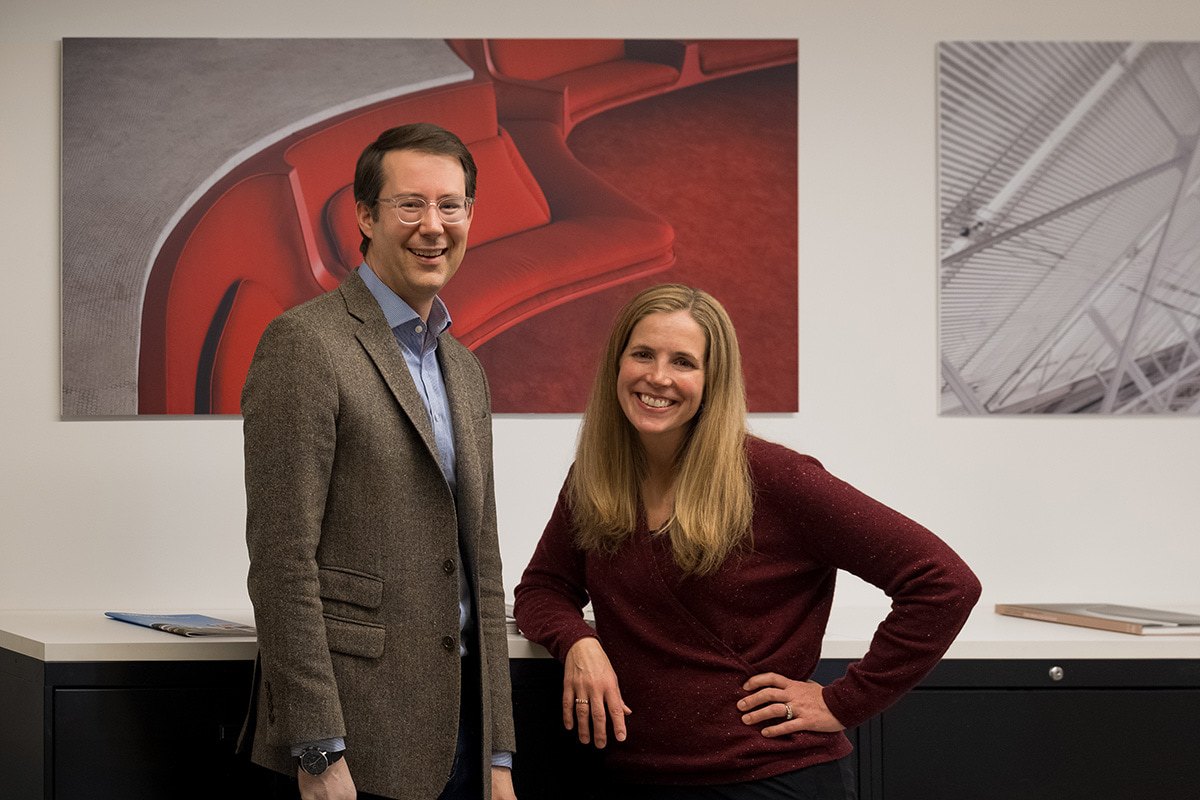
BBB Appoints Partners Jennie Gwin and Nathaniel Rogers as Directors of Historic Preservation
Their joint appointment both reasserts that stewardship of the built environment is the foundation of BBB’s philosophy and portfolio and reflects the evolution of historic preservation into an integrated and creative discipline. Today, preservation must resolve a greater range of considerations than ever before, from sustainability and resiliency, to housing scarcity and affordability, to elevating the narratives and built heritage of the historically marginalized, to the preservation, reconsideration, and expansion of cultural memory.
To this challenge Jennie Gwin brings more than 20 years of experience in historic preservation and adaptive reuse, with particular expertise in civic and historic rehabilitation tax credit projects, for public and private clients such as the National Park Service, Architect of the Capitol, US State Department, National Gallery of Art, Hines, and Vizcaya Museum and Gardens in Miami, FL. Her expertise combines the in-depth technical preservation knowledge and the planning for future programmatic needs that are necessary to ensure the longevity of historic buildings. She also works closely with clients to usher projects through regulatory approval processes and to find the financial solutions, such as historic tax credits, that make them possible. She is a board member of Docomomo DC and vice-chair of the AIA National Historic Resources HABS Knowledge Committee.
Nate Rogers specializes in the challenge of discovering opportunities in existing buildings and integrating transformational design within historic contexts with creativity and sensitivity, whether at the scale of a campus landscape or an interior space. He has focused his more than 20-year career on renovation, expansion, and adaptive reuse projects for cultural and higher education clients including Harvard University, Vanderbilt University, Yale University, and the Society of the Four Arts in Palm Beach, FL. Nate is an adjunct faculty member at the University of Pennsylvania’s Weitzman School of Design, where he teaches a graduate seminar on contemporary design in historic settings. He also serves on the Vestry of Trinity Church Wall Street and is a board member of The Evergreens Cemetery in Brooklyn, NY, and the Church Divinity School of the Pacific, an Episcopal seminary.
The position of Director inherits a legacy begun by James Marston Fitch, who held the title from 1979 until his death in 2000. Fitch was instrumental in transforming the grassroots field of historic preservation into an academic discipline of serious inquiry and intellectual rigor, establishing its first graduate program in the United States at Columbia University in 1964. Fitch’s insistence that existing buildings should be valued for their embodied energy and cultural continuity, and that reuse should be prioritized over new construction, has shaped BBB’s practice since the firm’s inception, and in recent decades has become a guiding principle of preservation industry-wide.
Jennie and Nate’s appointment comes at an inflection point not only in the trajectory of historic preservation as a discipline, but also in the evolution of BBB’s practice. Representing the third generation of preservation leadership at BBB, they inherit the role from Richard Southwick, FAIA, who has served as the firm’s Director of Historic Preservation since 2004 and will transition to Partner Emeritus status as of February 1, 2026. “It has been my thrill to have led the firm’s historic preservation efforts for the last twenty years, working on many of this country’s most important landmarks,” says Richard Southwick. “Two extraordinary preservation leaders will continue this strong tradition at Beyer Blinder Belle.”
Together, Jennie and Nate will lead a diverse team of professionals as they continue to advance BBB’s design-forward approach to historic preservation, which is guided by rigorous research, deep expertise, and a focus on long-term resiliency, relevance, and evolution. Under their leadership, BBB will continue to challenge the status quo in treating historic preservation not as an end in itself, but as a disciplined, imaginative practice for guiding meaningful change in the built environment.
“As contemporary designers working with historic buildings, it is our responsibility to reveal the layers of the past, while making buildings more functional, inclusive, and sustainable,” says Jennie Gwin. “It is an exciting time to lead a preservation practice, as we have more technical tools than ever to execute projects and, concurrently, we have moved to a more dimensional and nuanced approach to rehabilitation that allows for more creative dialogues with existing buildings.”
“I am a big believer in the unique capacity of contemporary design to contribute lasting value and meaning to our inherited buildings and places,” says Nate Rogers. “When historic preservation makes connections with people and the public realm, design is the medium. In our practice, historic preservation is first and foremost an act of imagination: a question of what could be.”